
DevHouse compact transformer substation is a prefabricated packaged substation that brings the medium voltage switchgear, the distribution transformer and the low voltage panel together in a single galvanised sheet steel enclosure. It is designed to IEC 62271-202; with rated voltages up to 36 kV and transformer ratings of 100 – 2500 kVA it is used in industrial plants, power stations and infrastructure projects.
What Is a Compact Transformer Substation (Sheet Steel Kiosk)?
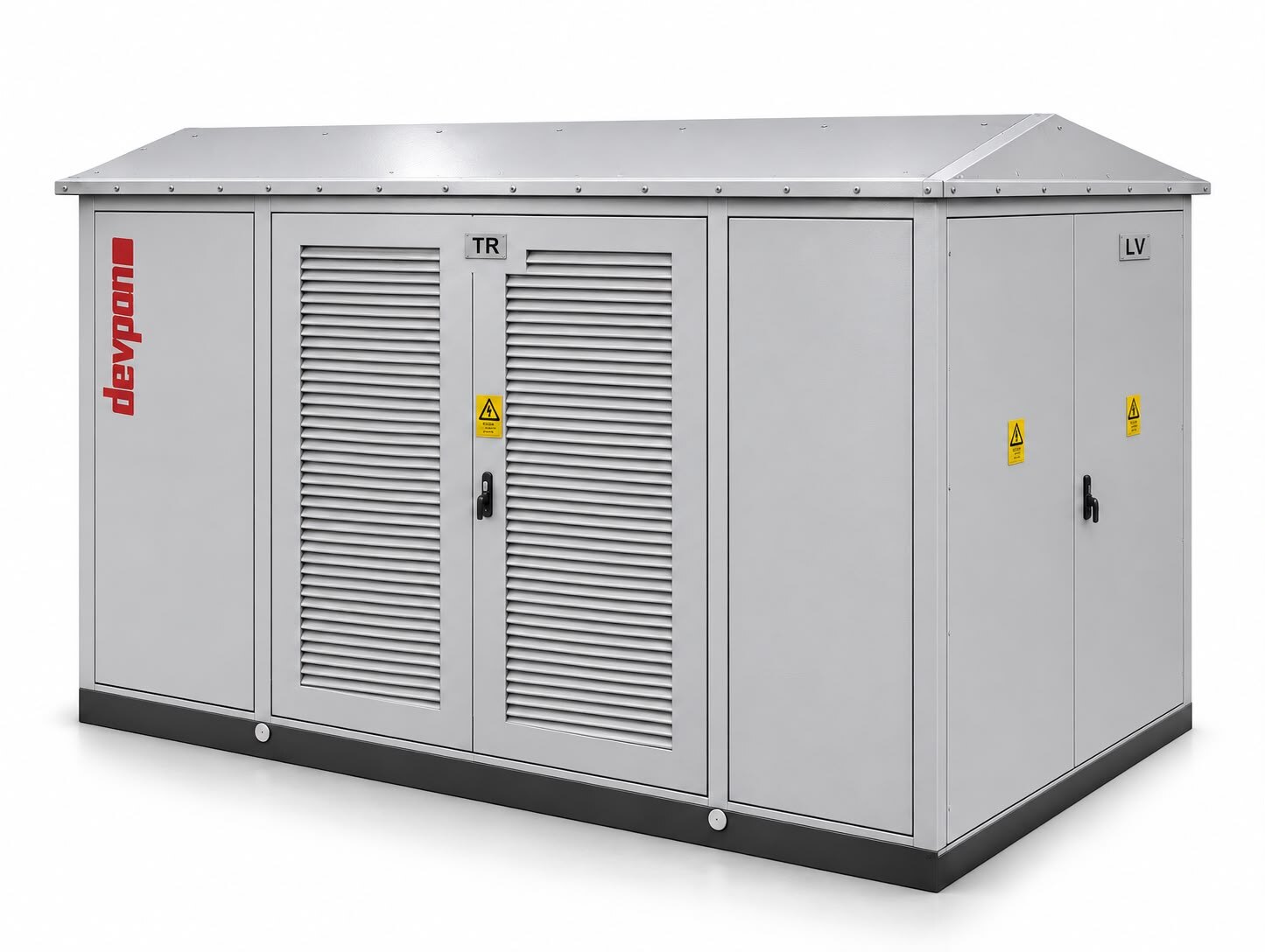
A compact transformer substation – widely known on site as a sheet steel kiosk – combines every item of equipment a distribution point needs inside one enclosure that is assembled, wired and tested in the factory and shipped as a single unit. Incoming medium voltage energy passes through the MV switchgear to the transformer, and from the transformer to the low voltage panel that feeds the installation.
The enclosure is manufactured from 2 – 3 mm hot-dip galvanised sheet steel and finished with electrostatic powder coating after surface preparation. This makes the kiosk resistant to moisture, corrosion, UV exposure and mechanical impact. Being considerably lighter than a concrete kiosk, it is easier to transport and to lift into position; placed on a prepared plinth, civil works are reduced to a minimum.
The modular design means the number of compartments, their dimensions and the door arrangement are set per project. As transformer rating increases, ventilation area and enclosure length grow accordingly; where required, compensation, generator infeed or metering compartments are added to the same body. DevHouse therefore suits permanent plant supplies as well as temporary points such as construction sites.
Three Compartments: Medium Voltage – Transformer – Low Voltage
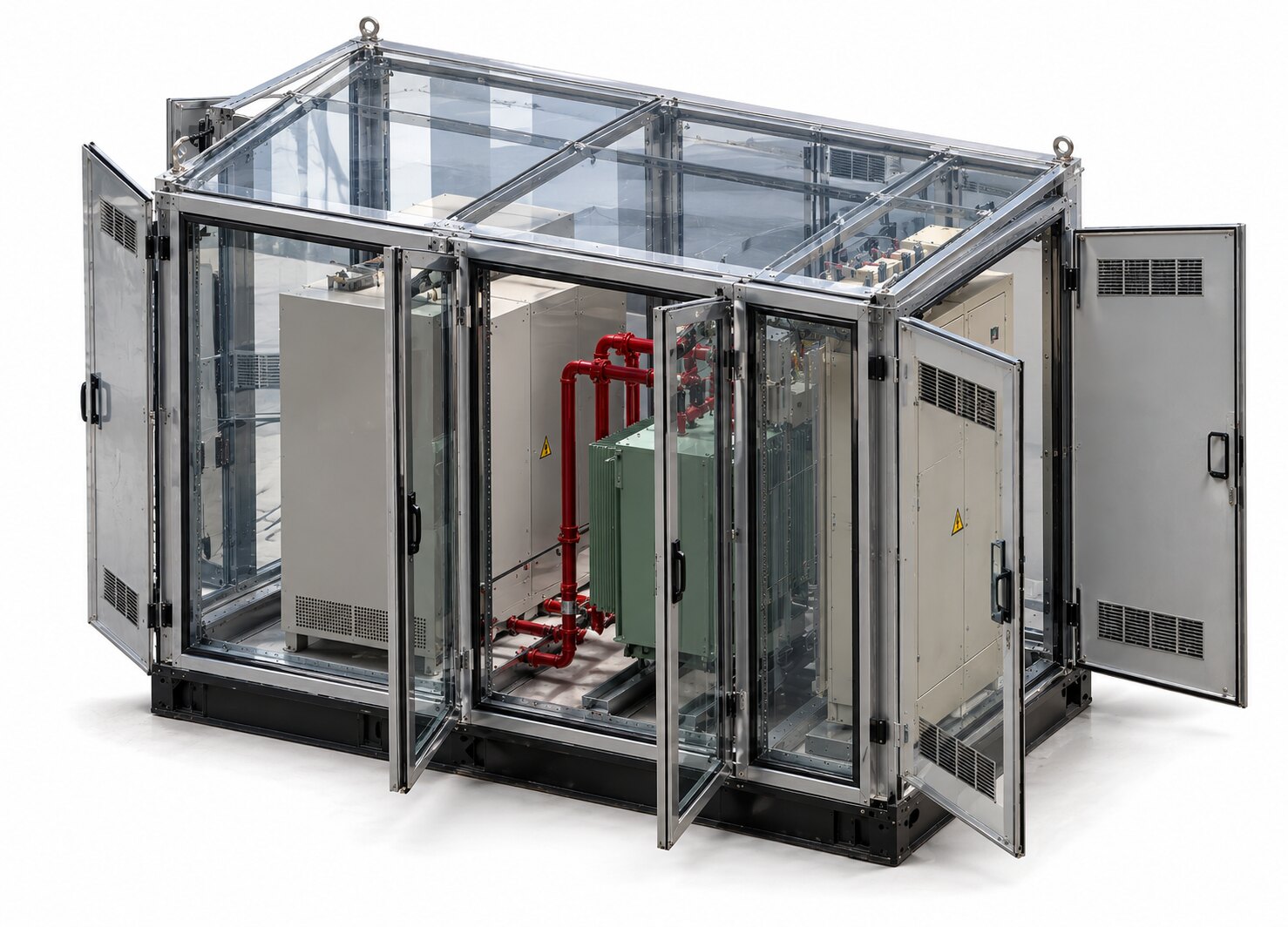
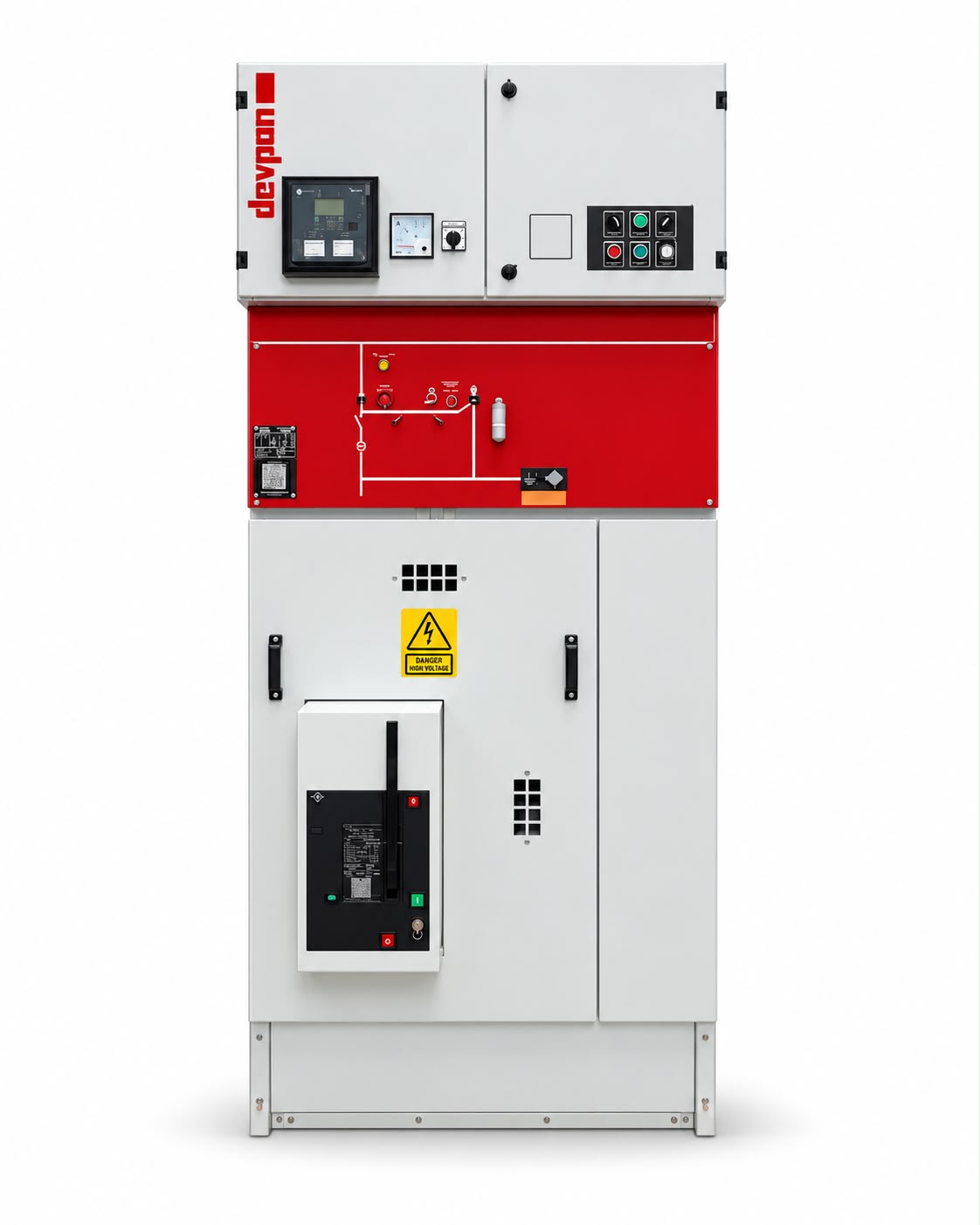
The medium voltage compartment is the kiosk’s connection to the network. A fuse-switch-disconnector unit is sufficient on radial feeders, while ring networks call for gas-insulated modular switchgear with two ring inlets and one transformer feeder. Where metering, bus coupling or circuit-breaker protection is required, the Dev24/36 metal-enclosed switchgear series is used.
The transformer compartment houses an oil-immersed or cast-resin distribution transformer. It is dimensioned with louvred bottom and top ventilation openings sized to remove the heat produced by transformer losses. In projects with oil-immersed transformers, a sealed oil containment sump able to hold the full oil volume is built into the floor.
The low voltage compartment contains the incoming device on the transformer secondary, the outgoing ways and the metering circuits. It is engineered as a main distribution board selected from our low voltage panel family; where power factor correction is needed it is added to the same enclosure as a separate compartment.
The compartments are separated by metal barriers and each is served through its own lockable door, so a technician working on the low voltage side cannot reach the medium voltage compartment. Operational safety is reinforced by mechanical interlocks between compartments and by warning labels.
Technical Specifications
The table below shows typical ratings and configuration options for the DevHouse compact transformer substation. Each kiosk is engineered to order, so the values are fixed according to transformer rating, network topology and the distribution utility specification.
| Property | Value / Option |
|---|---|
| Applicable standards | IEC 62271-202 (prefabricated substation), IEC 62271-200 (MV switchgear), IEC 61439-1/-2 (LV assembly), IEC 60076 (distribution transformer) |
| Rated voltage (Ur) | 12 kV / 24 kV / 36 kV |
| Rated lightning impulse withstand voltage (Up) | 75 / 125 / 170 kV peak |
| Rated frequency | 50 Hz |
| Transformer rating | 100 – 2500 kVA; oil-immersed or cast-resin distribution transformer |
| Low voltage rated current | 630 – 4000 A |
| Short-time withstand current | 16 – 25 kA / 1 s |
| Enclosure material | 2 – 3 mm hot-dip galvanised steel; aluminium or stainless steel optional |
| Surface finish | Electrostatic powder coating after surface preparation; RAL 7035 / RAL 7032 standard, project colours optional |
| Degree of protection | Outer enclosure up to IP34D; internal compartments IP2X |
| Mechanical impact resistance | Up to IK10 |
| Compartment arrangement | Medium voltage – transformer – low voltage; individually lockable doors and metal barriers |
| Ventilation | Louvred natural ventilation; thermostat-controlled forced cooling at higher ratings |
| Internal arc classification | IAC A 16 – 20 kA / 1 s at switchgear and panel level |
| Cable entry | Bottom cable trench or cable basement; gasketed and rodent-protected sealing |
| Earthing | Separate protective and system earthing bars; equipotential bar and external earthing terminal |
| Oil containment | Full-volume sealed oil sump for oil-immersed transformer applications |
| Ambient conditions | −25 °C … +40 °C; standard up to 1000 m altitude, derating above |
| Installation | On a concrete foundation or prefabricated plinth; crane lifting lugs and forklift pockets |
| Options | Compensation compartment, generator infeed, metering compartment, lighting and socket installation, fire detection, remote terminal unit and SCADA integration |
The values are typical application ranges; final ratings are fixed after the single line diagram, transformer selection, thermal calculation and short-circuit study.
Configuration According to the Project
Enclosure material and surface protection
The standard solution is 2 – 3 mm hot-dip galvanised steel. For coastal sites, mining areas or plants exposed to chemicals, sheet thickness is increased and stainless steel or aluminium enclosures are considered. Surface preparation and powder coating thickness are set according to the corrosivity category.
Compartment layout and access safety
The number of compartments follows from the medium voltage function, transformer type, number of low voltage outgoing ways and any compensation requirement. Each compartment is served through its own door; metal barriers and mechanical interlocks between compartments prevent unauthorised access and incorrect operation.
Ventilation and thermal design
Transformer load and no-load losses turn into heat, and failing to remove that heat shortens transformer life. Louvre areas are calculated from transformer rating and ambient temperature. At higher ratings, or in enclosed layouts, thermostat-controlled forced cooling is added.
Monitoring, automation and extra compartments
With a motorised mechanism, fault indicator and remote terminal unit, the kiosk can be monitored and operated from a control centre. Power analysers, generator infeed, metering and compensation are integrated into the same enclosure, removing the need for additional structures on site.
Where Is DevHouse Used?
A compact transformer substation is preferred where construction time has to be kept short, where energy is distributed from points spread across the site, and where the ability to relocate the kiosk is an advantage. Devpan compact transformer substations are applied in the following project types.
- Industrial plants and organised industrial zones
- Solar and wind power plant collection stations
- Residential developments and mass housing projects
- Shopping centre, campus and hospital sites
- Mining areas, cement and quarry plants
- Metro, port, airport and water treatment infrastructure
- Data centre and logistics facility incoming supply points
- Construction sites and temporary supply points
Relevant Technical Information
Frequently Asked Questions
What is the difference between a compact transformer substation and a concrete kiosk?
Both do the same job; the difference lies in the enclosure material and in how the unit reaches the site. A sheet steel kiosk is made of galvanised steel, is considerably lighter than a concrete kiosk and is lifted into place as a single unit; it can be dismantled and relocated when required. A concrete kiosk is heavier and is treated as a permanent structure. Where fire resistance, mechanical impact and sound insulation are the leading criteria, concrete is chosen; where speed and mobility come first, a sheet steel enclosure is preferred.
Up to which transformer rating can a compact substation be used?
The typical application range is 100 – 2500 kVA. What really governs the limit is not the rating itself but whether the heat produced by transformer losses can be removed. As the rating rises, louvre area, compartment volume and enclosure length increase; beyond a certain point thermostat-controlled forced cooling is added. The upper limit is therefore set together with ambient temperature and installation conditions.
How is ventilation sized in a sheet steel kiosk?
The ventilation area is calculated from the transformer load and no-load losses, the compartment volume, the design ambient temperature and the permissible temperature rise. Cool air enters through the lower louvre and warm air leaves through the upper one. If the calculation shows natural ventilation to be insufficient, a fan-assisted solution is applied; louvres are fitted with insect and rodent protection mesh.
Which standards apply to a compact transformer substation?
The assembled unit is assessed under IEC 62271-202. Within the enclosure, the medium voltage switchgear is selected to IEC 62271-200, the low voltage assembly to IEC 61439-1 and IEC 61439-2, and the distribution transformer to IEC 60076. Degree of protection is defined to IEC 60529 and mechanical impact resistance to IEC 62262.
How are installation and commissioning carried out on site?
The kiosk is assembled and tested in the factory and shipped as one unit. On site it is craned onto a prepared concrete foundation or plinth, then the earthing connections and the medium and low voltage cables are pulled in. Commissioning covers insulation measurement, earth resistance measurement, entry of protection settings and functional testing. We provide this service with our own field team.
Medium Voltage Switchgear Used Inside the Kiosk
Let us size your transformer substation together
Whether you have a transformer rating, a medium voltage function or simply a site layout, our engineering team will define the compartment arrangement, the ventilation calculation and the automation level with you. You can also review our complete medium voltage switchgear family and our low voltage panels for distribution downstream of the transformer.