
The DevPanel main distribution board (MDB) is the low voltage switchboard that receives the full power from a facility’s transformer or generator and distributes it to the sub-distribution boards. It is built on an enclosure and busbar system verified to IEC 61439-1 / IEC 61439-2; the main busbar, rated up to 6300 A, is configured for each project with Form 1 – Form 4b internal separation and air circuit breaker (ACB) solutions.
What Is a Main Distribution Board and Where Is It Used?
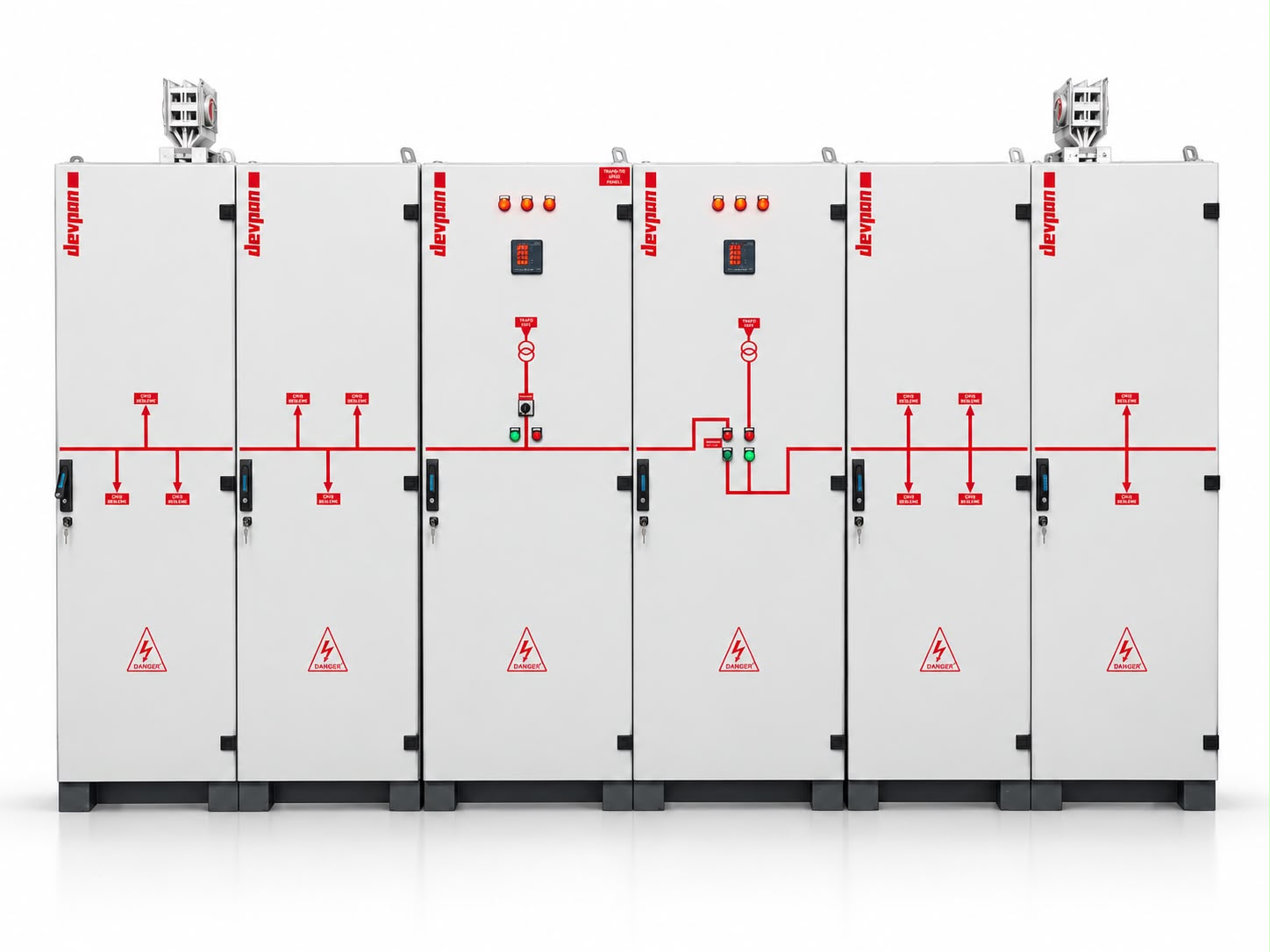
The main distribution board is the most critical link in an electrical installation: this is where short-circuit currents are highest, where selectivity must be designed most carefully and where downtime during maintenance costs the most. That is why DevPanel is not a single catalog product but a modular switchboard system configured in each project according to the load list and short-circuit calculation.
The switchboard is built on a compartment principle: the incomer breaker compartment, busbar compartment, outgoing feeder compartments and cable compartment are separated from each other according to the form of separation. This way, the main busbar and other feeders can stay energized while work is carried out on one outgoing feeder, protecting both occupational safety and business continuity.
For metering and monitoring, energy analyzers, current transformers, phase indicators and communication modules are integrated into the switchboard. The main distribution point thus becomes not only the point that distributes energy but also the first point where the facility generates energy data.
Technical Specifications
The table below shows typical design ranges and options for the DevPanel main distribution board. Since switchboards are engineered to order, the values are determined according to the facility’s load profile.
| Property | Value / Option |
|---|---|
| Applicable standard | IEC 61439-1 (general rules), IEC 61439-2 (power switchgear and controlgear assemblies) |
| Rated insulation voltage (Ui) | 1000 V |
| Rated impulse withstand voltage (Uimp) | 8 kV |
| Main busbar rated current | 630 – 6300 A |
| Short-time withstand current / peak withstand current | 65 – 100 kA (1 s) / 143 – 220 kA peak |
| Main breaker | Air circuit breaker (ACB) or molded case circuit breaker (MCCB); motor operator optional |
| Functional unit type | Fixed-connection, plug-in or withdrawable |
| Internal separation (forms) | Form 1, Form 2a/2b, Form 3a/3b, Form 4a/4b |
| Access direction | Front or front + rear access |
| Enclosure | Cold-rolled (DKP) sheet steel; frame 2 mm, doors and covers 1.5 – 2 mm |
| Surface treatment | Electrostatic powder coating, standard RAL 7035 (different RAL colors available upon request) |
| IP rating | IP31 / IP41 / IP54 |
| Cable entry | Bottom or top; separate cable compartment |
| Measurement and monitoring | Energy analyzer, current transformers, ammeter/voltmeter, phase indicator lamps |
| Communication | Modbus RTU / Modbus TCP (optional) |
| Redundancy and transfer | Mains–generator transfer, dual transformer supply, interlocked breaker arrangement |
The values given are typical application ranges; final ratings are determined after the single-line diagram, short-circuit and selectivity calculations.
Configuration According to the Project
Main breaker selection: ACB or MCCB
Above 630 A, an air circuit breaker (ACB) is preferred: its adjustable trip units allow selectivity with downstream breakers to be set more precisely. For lower ratings, a molded case circuit breaker (MCCB) offers both space and cost advantages.
Fixed, plug-in or withdrawable construction
Outgoing units can be fixed, or withdrawable in critical facilities. With a withdrawable design, a faulty unit can be removed and replaced with a spare while the switchboard remains energized, significantly reducing downtime.
Form of separation and occupational safety
Whether maintenance will be carried out with the switchboard energized directly determines the form of separation. If work must be possible on one outgoing feeder while the others keep running, Form 3b or Form 4b is preferred.
Busbar system and short-circuit withstand
Main and distribution busbars are sized according to continuous current, short-time withstand current (Icw) and peak withstand current. Support spacing is determined by calculating electrodynamic forces, and connection torques are recorded.
In Which Projects Is DevPanel Used?
Because all of the transformer’s power passes through it, the main distribution board is usually installed in the transformer substation or main electrical room. Devpan main distribution boards are used in the following types of projects.
- Shopping malls and mixed-use projects
- Hospitals and health campuses
- Data centers and critical power facilities
- Production facilities and industrial factories
- Residential and high-rise building projects
- Hotels, convention centers and terminal buildings
- Water and wastewater treatment plants
- Schools, campuses and public buildings
Relevant Technical Information
Frequently Asked Questions
What is the maximum current rating of a main distribution board?
DevPanel main distribution boards are typically designed between 630 A and 6300 A. Not only the continuous current matters, but also the short-time withstand current (Icw) of the busbar system. Above 4000 A, busbar cross-section, support spacing and temperature-rise calculations become the main design inputs.
Which form of separation should be chosen for a main distribution board?
If the power can be switched off during maintenance, Form 2b is sufficient in most cases. In hospitals, data centers and continuous-production facilities where downtime is costly, Form 3b or Form 4b is preferred so that work can be carried out on one outgoing feeder while the others keep running. The choice is assessed together with occupational safety procedures.
Why is the Icw (short-time withstand current) value important?
Icw defines the current and duration the switchboard’s busbar system can withstand without damage until the breaker trips in the event of a short circuit. A switchboard rated below the value calculated from the transformer rating and network short-circuit power risks busbar deformation and arcing during a fault. That is why Icw is determined before the switchgear is selected.
What is the difference between a main distribution board and medium voltage switchgear?
Medium voltage switchgear operates on the primary side of the transformer, typically at voltages up to 36 kV, and protects the transformer. The main distribution board operates on the secondary side of the transformer, at low voltage below 1000 V, and handles distribution within the facility. The two are not alternatives but consecutive links in the same energy chain.
Other Low Voltage Switchboards


Let’s size your main distribution board together
Whether you have a single-line diagram, the transformer rating or just a load list, our engineering team carries out the short-circuit and selectivity calculations and works out the form of separation and busbar cross-section with you. For the medium voltage side, see our medium voltage switchgear.
Request a quote