
Product Family
Medium Voltage Switchgear Family
Medium voltage switchgear is metal-enclosed equipment that brings power at 1 kV to 36 kV into a facility and protects, meters and switches transformers, cables and the distribution network. Devpan’s two switchgear families cover the entire chain; all are manufactured according to IEC 62271-200 standards and undergo routine testing.AIS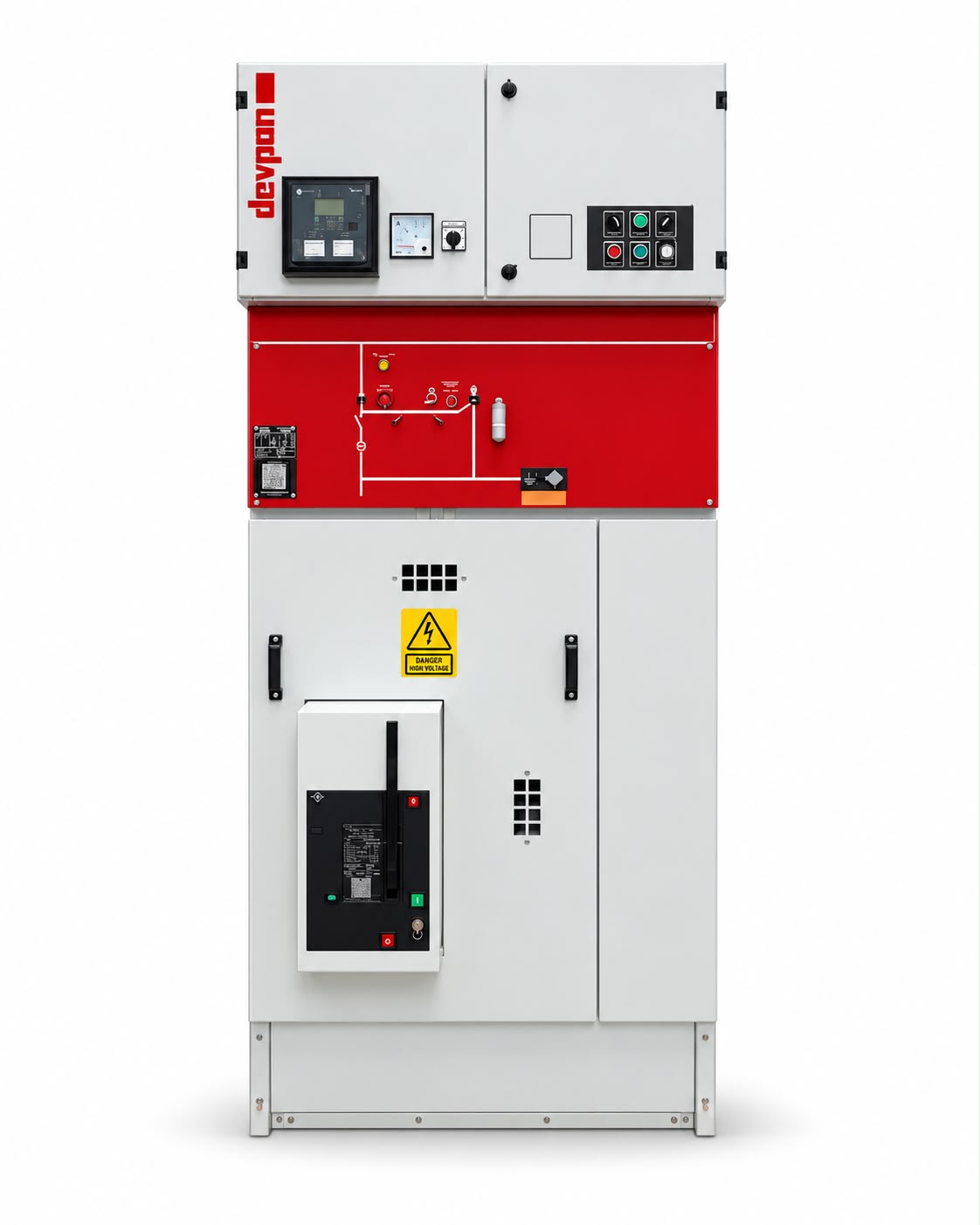 Dev24/36 Metal Enclosed Modular Switchgear Series is an air-insulated switchgear series providing incoming, metering, bus coupler and transformer protection functions at 24 kV and 36 kV in modules installed side by side. View productRMU
 DevRMU Gas-Insulated Ring Main Unit (RMU) Maintenance-free ring main unit combining two cable incomers and a transformer feeder in a single compact tank insulated with gas or dry air. View product
Dev24/36 Metal Enclosed Modular Switchgear Series is an air-insulated switchgear series providing incoming, metering, bus coupler and transformer protection functions at 24 kV and 36 kV in modules installed side by side. View productRMUDevRMU Gas-Insulated Ring Main Unit (RMU) Maintenance-free ring main unit combining two cable incomers and a transformer feeder in a single compact tank insulated with gas or dry air. View productSelection Guide
Which medium voltage switchgear goes where?
The choice is made based on the voltage level, whether the supply is radial or ring, short-circuit power, allocated volume, and whether interruptions during maintenance can be tolerated.| Switchgear family | Location and function in the facility | Typical ratings | Key equipment |
|---|---|---|---|
| Dev24/36 (Modular AIS) | Industrial and building transformer substation; modular incoming, outgoing and transformer protection line-ups | 24 / 36 kV / 630 – 1250 A / 16 – 25 kA | Switch-disconnector, fused switch-disconnector, fixed or withdrawable circuit breaker, earthing switch. |
| Gas-Insulated Ring Main Unit (RMU) | Ring network distribution point; compact and monoblock substations, outdoor distribution kiosks | 12 – 24 kV / 630 A ring, 200 A transformer feeder | Gas or dry-air insulated monoblock tank, switch-disconnectors, fused transformer feeder, cable test access |
The values in the table are typical application ranges; final values are set after the single-line diagram, protection coordination and short-circuit calculations.
Design Principles
Standards and Design Principles
The quality of switchgear depends more on how it is designed as a system than on the circuit breaker inside it. Four key factors are decisive.01
IEC 62271-200 verification
Metal-enclosed switchgear is evaluated according to IEC 62271-200 in terms of dielectric strength, main circuit resistance, short-time and peak withstand current, and mechanical operation. Circuit breakers are selected according to IEC 62271-100, and disconnectors and earthing switches according to IEC 62271-102; each switchgear undergoes routine testing after production.02
Internal arc classification (IAC) and LSC category
Internal arc classification ensures that pressure and hot gases from an arc fault are not released towards personnel; it is defined as IAC A or B by accessibility and FL/FLR by protected sides. The ability to keep other compartments energized while one is open is expressed by the LSC1/LSC2A/LSC2B category.03
Busbar systems and short-circuit withstand
Main and branch busbars are sized according to rated current, short-time withstand current (Ik) and peak withstand current (Ip). Support spacing is determined according to electrodynamic forces, and insulation clearances are set with epoxy post insulators and heat-shrink insulation.04
Protection, measurement and communication
Overcurrent, earth fault and voltage protection is provided by digital relays; settings are determined through a selectivity study with the low voltage circuit breakers. The ratio, accuracy class, and power of current and voltage transformers are selected according to measurement and protection requirements; SCADA integration is included in the design.Production Process
From Design to Commissioning
Design, manufacturing and commissioning are all done in-house; our project design and project management teams monitor the process from start to finish.- Network data and single-line diagram: A single-line diagram is designed based on the distribution company’s short-circuit power, voltage level, number of supplies, loop structure, and transformer capacities.
- Switchgear layout and approval: the function sequence, busbar routing, cable entries, arc venting duct and room layout are drawn; manufacturing starts only after approval.
- Sheet metal work and enclosure manufacturing: the sheet steel is cut and bent; partition walls and pressure relief flaps are mounted, and electrostatic powder coating is applied.
- Busbar, switchgear and secondary assembly : Electrolytic copper busbars are processed; circuit breakers, disconnectors, measuring transformers, protection relays and secondary cabling are assembled and labeled.
- Routine testing and commissioning includes dielectric testing, main circuit resistance measurement, mechanical interlocking and protection function tests; on-site assembly and commissioning support is provided.
In short: what each switchgear family does
- Dev24/36 (Metal-Enclosed AIS): 24 kV / 36 kV metal-enclosed modular switchgear series; incoming, metering, bus coupler and transformer protection modules are arranged side by side.
- Gas-Insulated Ring Main Unit (RMU): a gas-insulated ring main unit combining two ring incomers and a fused transformer feeder in a single compact tank.
Frequently Asked Questions
Frequently Asked Questions
Which standard is medium voltage switchgear built to?
Medium-voltage switchgear with metal enclosures is manufactured according to the IEC 62271-200 standard. This standard defines the enclosure type, compartmentalization, IP rating, internal arc classification, and applicable type and routine tests of the switchgear. The circuit breaker inside the switchgear is selected according to IEC 62271-100, disconnectors and earthing switches according to IEC 62271-102, and the current and voltage transformers according to the IEC 61869 series.
What is the difference between metal-clad and metal-enclosed switchgear?
Both have metal enclosures; the difference lies in the degree of compartmentalization. In a metal-clad enclosure, the circuit breaker, busbar, cable, and low-voltage compartments are separated by earthed metal partitions, and the circuit breaker is usually withdrawable; this allows the other compartments to stay energized while one is being worked on. In metal-enclosed modular switchgear, the separation between compartments may be an insulating partition instead of a metal one, or the number of compartments may be fewer; this reduces investment costs and the required volume.
Where is a Gas-Insulated Ring Main Unit (RMU) used?
RMUs are used in medium-voltage networks where power is distributed in a ring shape. Because two ring cable connections and one or more transformer feeders are combined in a single compact enclosure, they are preferred in compact substations, monoblock substations, and field applications with space constraints. Since the power supply continues from the other end of the ring when a fault occurs in one cable, the interruption time is shortened.
What does the internal arc classification (IAC) mean?
Internal arc classification describes the switchgear’s ability, in the event of an arc fault, to keep pressure and hot gases away from areas where personnel stand, keep doors closed and prevent fragmentation of the enclosure. Situations where access is only permitted to authorized personnel are classified as Class A, while those accessible to the public are classified as Class B; protected areas are indicated by the letters front (F), side (L), and rear (R). The arc venting duct and room height are taken into account at the design stage.
Which type of circuit breaker is used in a medium voltage switchgear?
In modern medium-voltage applications, vacuum circuit breakers are the standard solution. The arc formed during contact opening is extinguished in a vacuum environment at the zero crossing of the current; they offer high breaking capacity, long mechanical life, and low maintenance requirements. Switch-fuse combinations, on the other hand, provide a cost advantage in transformer protection feeders and in situations where the short-circuit current can be limited by a fuse.
What is the relationship between a medium-voltage switchgear and a low-voltage panel?
Medium-voltage switchgear is located on the primary side of the transformer and protects both the transformer and the medium-voltage cable. Low-voltage switchgear, on the other hand, is located on the secondary side of the transformer and handles in-house distribution at voltages below 1000 V. The two groups are not alternatives to each other, but successive links in the same energy chain; their protection settings are determined through selectivity studies along this chain.
Where is Devpan medium voltage switchgear used?
Devpan medium voltage switchgear is used in substations of residential and mixed-use projects, shopping malls, hospitals, schools and campuses, data centers, hotels, and manufacturing facilities. You can access application examples on our reference projects page.