
The DevPower Lighting & Power Distribution Board is a low voltage board that brings a building’s lighting and socket/small power circuits together in a single switchboard, with group control and energy monitoring functions. It is designed for rated currents of 100–800 A and includes contactor-based group control, time and astronomical relays, residual current protection and fault signaling.
What Is a Lighting and Power Distribution Board?
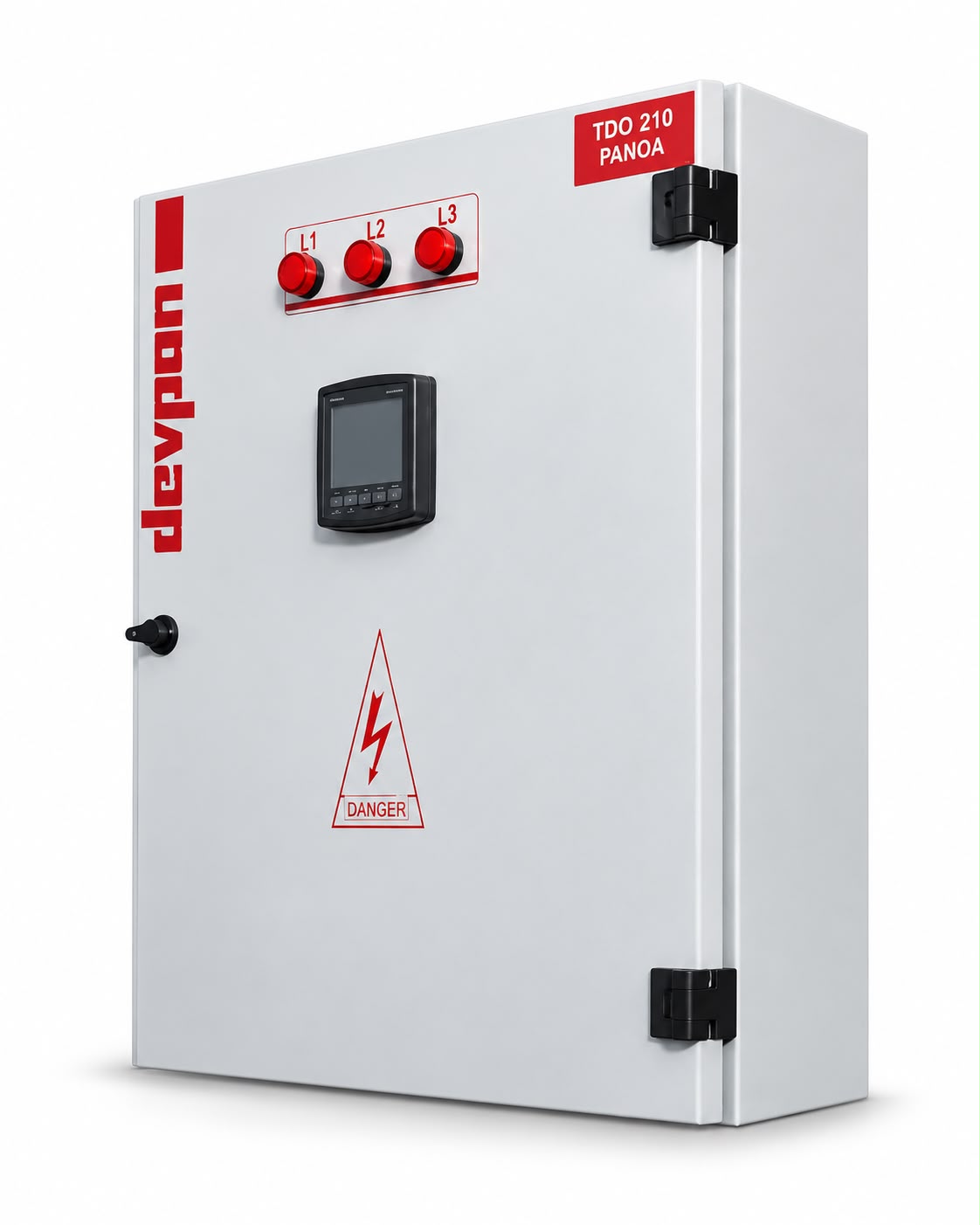
In a building, lighting and socket circuits differ in both character and operation: lighting groups are switched on and off centrally and their operating hours follow a schedule, whereas socket circuits stay energized continuously and need more sensitive protection against electric shock. DevPower brings these two worlds together in a single board, but in separate circuit groups.
On the lighting side, each group is controlled via a contactor. The control signal can come from a local switch, a floor push button, a time relay, an astronomical relay, a twilight switch or the building automation system. Common area lighting can thus be managed automatically according to a calendar and sunrise/sunset times.
The front of the board carries phase indicator lamps, fault and alarm indications and the main switch; the energy consumption of lighting and socket groups can be monitored separately with a digital multimeter or energy analyzer. This provides reliable data for energy efficiency studies.
Technical Specifications
DevPower boards are configured according to the room list and lighting scenario. The table below summarizes standard and optional equipment.
| Property | Value / Option |
|---|---|
| Applicable standard | IEC 61439-1, IEC 61439-2; IEC 61439-3 for distribution boards operated by ordinary persons (DBO) |
| Rated current | 100 – 800 A |
| Main protection | Molded case circuit breaker (MCCB) or switch-disconnector; main switch operated from the front |
| Outgoing circuit arrangement | Lighting circuits (L1–Ln) and socket / power circuits (P1–Pn) in separate blocks |
| Group control | Contactors; local switch, time relay, astronomical relay, twilight switch |
| Building automation | BMS dry contact interface; KNX or DALI integration (optional) |
| Residual current protection | 30 mA on socket circuits; 100/300 mA on lighting and main supply circuits |
| Surge protection | Type 2 surge protective device (SPD) with backup fuse |
| Signaling | Phase indicator lamps, fault and alarm lamps, volt-free alarm contact |
| Measurement | Digital multimeter or energy analyzer; per-group current measurement optional |
| Emergency lighting | Separately supplied emergency lighting circuits, connection to generator or central battery system |
| Mounting | Wall-mounted or floor-standing |
| IP rating | IP41 / IP54 |
| Labeling | Engraved labels with circuit number and location, single-line diagram inside the door |
The values given are typical application ranges; final ratings are determined after the single-line diagram, short-circuit and selectivity calculations.
Four Decisions in Lighting Board Design
Separating lighting and power circuits
When lighting and socket circuits are grouped in separate blocks, work on one group does not affect the other, and energy consumption can be measured per group. This separation is also the basis for energy efficiency reporting.
Group control scenarios
Common area lighting can be linked to a calendar, sunrise/sunset times, motion sensors or the building automation system. Because an astronomical relay calculates day length automatically from the location, no seasonal adjustment is needed.
Emergency lighting and backup supply
Lighting for escape routes and critical areas is grouped in a separate circuit block, which is segregated so that it can be supplied by a generator, UPS or central battery system. This keeps the block energized in the event of a power outage.
Energy monitoring and reporting
With an energy analyzer and per-group current measurement, you can see how much each area consumes. The data can be transferred via Modbus to the building automation or SCADA system for reporting.
Where Is DevPower Used?
Lighting and power distribution boards are used in any building where common area lighting is managed centrally.
- Shopping mall common area and car park lighting
- Floor distribution boards for office buildings and business centers
- Hospital corridor and ward lighting
- School, dormitory and campus blocks
- Hotel floor, lobby and exterior lighting
- Factory production area and site lighting
- Terminal, tunnel and platform lighting
- Outdoor lighting in residential developments
Relevant Technical Information
Frequently Asked Questions
What is the difference between a lighting board and a sub-distribution board?
A sub-distribution board is general-purpose and meets all the power supply needs of an area. A lighting and power board, by contrast, focuses on central control of lighting groups: contactor-based group control, time and astronomical relays, segregated emergency lighting and per-group energy metering are its characteristic features.
Is residual current protection mandatory on socket circuits?
Because sockets are directly within people’s reach, 30 mA residual current protection is essential for safety. In addition, when different socket groups, such as IT, kitchen and outdoor sockets, are protected by separate devices, a fault affects only the relevant group rather than the whole building.
How are lighting groups controlled?
The most common solution is to control each group via a contactor. The contactor coil can be energized by a local push button, time relay, astronomical relay, twilight switch, motion sensor or building automation system. The board can also include a manual/auto selector switch so that lighting can be operated manually if the automation system is out of service.
How is an emergency lighting circuit supplied?
The emergency lighting group is assembled in a circuit block separate from normal lighting and is supplied from the generator panel, a UPS output or a central battery system. Even if escape route luminaires have their own batteries, being able to monitor the group via a separate circuit makes maintenance and testing easier.
Other Low Voltage Switchboards


Share your room list and let’s design your lighting board together
If you know your lighting groups, control scenarios and emergency lighting needs, we can determine the circuit plan, control scheme and energy monitoring level together. For the sub-distribution side, see the DevBox page.
Request a quote