
The Dev24/36 metal-enclosed modular switchgear series is an air-insulated (AIS) switchgear system that builds medium voltage functions from independently arranged modules. Designed to IEC 62271-200, it forms incoming, metering, bus coupler and transformer protection line-ups in building and industrial substations, with rated voltages of 24 kV and 36 kV, a main busbar rated up to 1250 A and short-time withstand currents up to 25 kA.
What Is Metal-Enclosed Modular Switchgear?
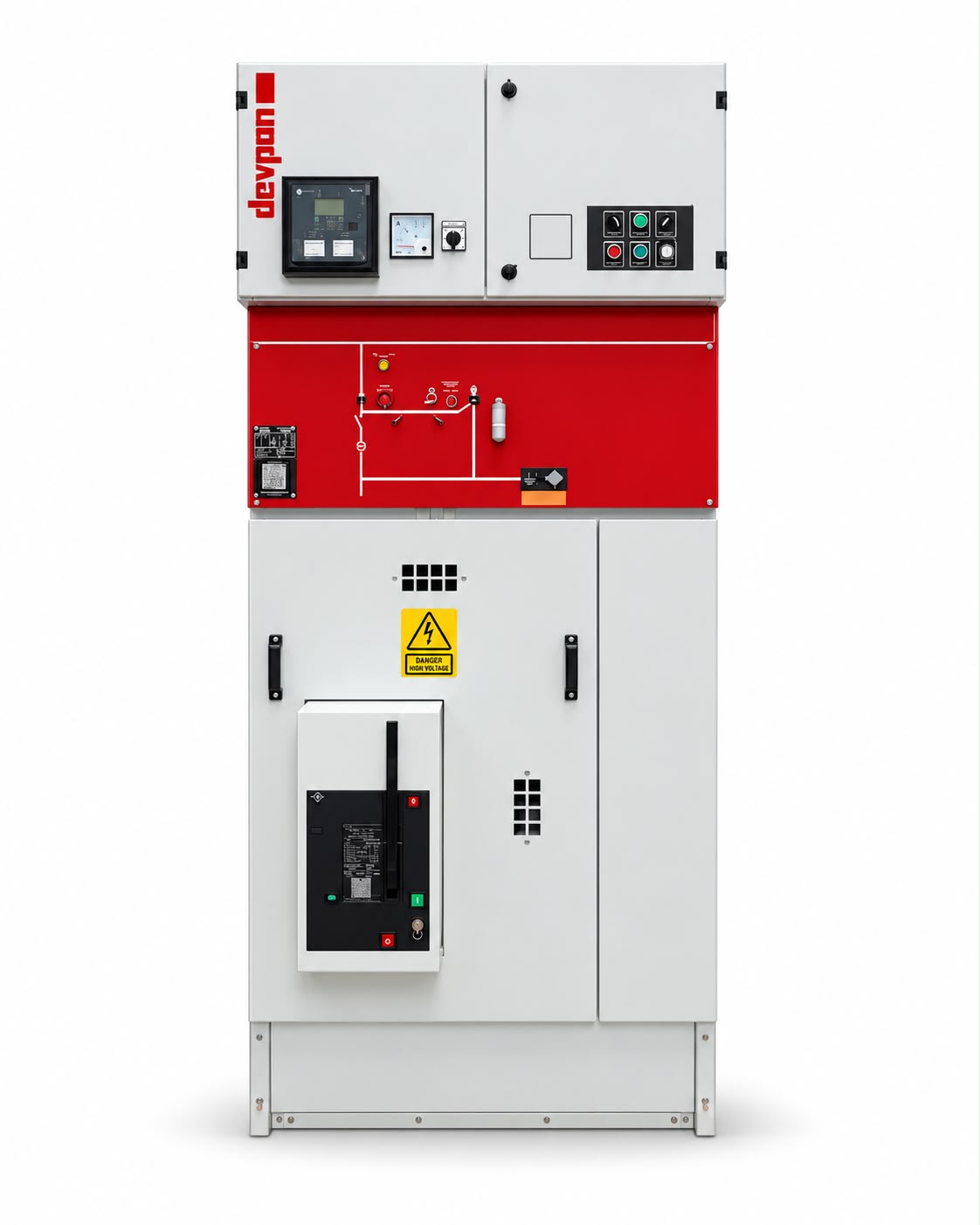
Metal-enclosed modular switchgear is a medium voltage solution in which each function is housed in its own metal enclosure and the enclosures are connected to each other via the main busbar. New modules can be added to the line-up as the facility grows; this flexibility makes the Dev24/36 series stand out in phased industrial plants and multi-stage construction projects.
The series consists of a switch-disconnector incoming module, a fused switch-disconnector transformer feeder, a circuit breaker feeder, a voltage and current metering module, a bus coupler and a busbar riser module. These modules are arranged in a logical sequence from left to right according to the facility’s single-line diagram; each module includes an earthing switch and a capacitive voltage indicator.
The insulating medium is air, so maintenance access is easy and repair and extension costs are low. In 36 kV applications, module width and depth increase with the larger insulation clearances, and post insulators and busbar insulation are selected accordingly. Mechanical interlocks prevent incorrect switching operations and access to live parts.
Technical Specifications
The table below shows typical design ranges and module options for the Dev24/36 modular switchgear series. Since the switchgear is engineered to order, the values are determined according to the network voltage, short-circuit power and functional requirements.
| Property | Value / Option |
|---|---|
| Applicable standards | IEC 62271-200 (switchgear), IEC 62271-100 (circuit breakers), IEC 62271-102 (disconnectors and earthing switches) |
| Rated voltage (Ur) | 24 kV / 36 kV |
| Rated lightning impulse withstand voltage (Up) | 125 kV / 170 kV peak |
| Rated short-duration power-frequency withstand voltage (Ud) | 50 kV / 70 kV (1 minute) |
| Rated frequency | 50 Hz |
| Main busbar rated current | 630 / 800 / 1250 A |
| Short-time withstand current / peak withstand current | 16 – 25 kA (1 s) / 40 – 63 kA peak |
| Module types | Switch-disconnector incomer, fused switch-disconnector transformer feeder, circuit breaker feeder, metering module, bus coupler, busbar riser |
| Switching and isolating devices | Vacuum circuit breaker (fixed or withdrawable), switch-disconnector, disconnector, HV HRC fuses |
| Earthing | Each module has a short-circuit-making earthing switch. |
| Partitioning | Metal enclosure; loss of service continuity category LSC2A, partition class PI or PM |
| Internal arc classification | IAC A; FL/FLR accessibility, top or rear venting (optional) |
| Insulation medium | Air (AIS); epoxy post insulators, heat-shrink busbar insulation |
| Metering and protection | Current transformers, voltage transformers, digital protection relay, ammeter and voltmeter, capacitive voltage indicator |
| Interlocks | Mechanical interlocking: disconnector – earthing switch – door interlock chain, key interlocks |
| Enclosure | Cold-rolled (DKP) or aluminum-zinc coated sheet steel; frame 2 mm, doors and covers 1.5 – 2 mm |
| Surface treatment | Electrostatic powder coating, standard RAL 7035 (different RAL colors available upon request) |
| Cable connection | Bottom entry for XLPE cables; separate cable compartment with access to cable terminations |
| Communication | Modbus RTU / Modbus TCP (optional) |
| Expandability | Modules can be added to the right or left via the main busbar |
The values given are typical application ranges; final ratings are determined after the single-line diagram, protection coordination and short-circuit calculations.
Configuration According to the Project
Module types and functional arrangement
The line-up follows the energy flow in the single-line diagram: incoming module, metering module, a bus coupler if required, then transformer or circuit breaker feeders. The right arrangement simplifies the switching sequence and shortens cable routes and room layout.
Fused switch-disconnector or circuit breaker feeder?
For small and medium transformer ratings, a fused switch-disconnector is an economical, space-saving solution; the fuse limits the short-circuit current. For feeders that require adjustable protection, selectivity and frequent switching, vacuum circuit breaker modules are preferred. The decision takes the transformer rating and protection coordination into account.
24 kV and 36 kV insulation coordination
At 36 kV, module width, depth and busbar support spacing increase because of the higher lightning impulse withstand level and larger insulation clearances. Altitude, humidity, pollution and ambient temperature are also inputs to insulation coordination; a correction factor is applied above 1000 m.
Busbar system, interlocks and occupational safety
The main busbar is sized according to its continuous current and short-circuit withstand capability; support spacing is determined according to electrodynamic forces. The interlock chain ensures operational safety by preventing the cable compartment from being opened, and incorrect switching operations, before the earthing switch is closed.
Which Projects Use Dev24/36?
The modular switchgear series is preferred in medium-sized substations and in facilities expanding in phases. Devpan metal-enclosed modular switchgear is used in the following types of projects.
- Industrial facilities and manufacturing plants
- Customer substations in organized industrial zones
- Residential complexes and mixed-use projects
- Shopping malls and hotel buildings
- School, campus and public buildings
- Solar and wind power plant collector substations
- Water and wastewater treatment plants
- Cold storage facilities and logistics centers
Relevant Technical Information
- Medium voltage switchgear family and selection guide
- Current-carrying capacities of copper busbars
- Cable current-carrying capacities
- Current transformer selection and C/k setting
- IP rating table and selection criteria
- Low voltage switchboards
- Our reference projects
- Switchgear commissioning and maintenance service
Frequently Asked Questions
Which modules make up the Dev24/36 switchgear series?
The series consists of a switch-disconnector incoming module, a fused switch-disconnector transformer feeder, a circuit breaker feeder, a current and voltage metering module, a bus coupler and a busbar riser module. The modules are connected via the main busbar, and new modules can be added as the facility grows.
When is a fused switch-disconnector sufficient for a transformer feeder?
Where the transformer rating is limited and the short-circuit current can be safely limited by an HV HRC fuse, a fused switch-disconnector is sufficient and reduces investment cost and space. For feeders that require adjustable protection, selectivity and frequent switching, a vacuum circuit breaker module is preferred.
Why are insulation clearances larger in 36 kV switchgear?
As the rated voltage increases, so do the lightning impulse and power-frequency withstand voltages; these values determine the phase-to-phase and phase-to-earth air clearances. That is why module width, depth and busbar support spacing are larger at 36 kV than in 24 kV solutions.
How do I choose between modular and metal-clad switchgear?
The deciding factors are the maintenance scenario and the short-circuit level. If the relevant busbar section can be de-energized during maintenance and the short-circuit level stays within 25 kA, modular switchgear is sufficient. Where interruptions are costly, the short-circuit level is high and withdrawable circuit breakers are required, metal-clad switchgear is preferred.
Can modules be added to an existing switchgear line-up later?
Yes. As long as the main busbar system and busbar riser module are suitable, a new module can be added to the right or left of the line-up. Beforehand, the rated current, short-circuit withstand and room layout of the existing busbar are checked, and the work is carried out according to a planned outage.
Let’s plan your modular switchgear line-up together
Whether you have a single-line diagram, transformer ratings or just a list of requirements, our engineering team will work with you to determine the module types, line-up sequence, main busbar rating and protection settings. You can also explore our full medium voltage switchgear range and low voltage switchboards for distribution downstream of the transformer.