
The DevControl MCC panel (Motor Control Center) is a low voltage switchboard that combines the protection, control and monitoring of all motor feeders in a facility in a single switchboard system. Built with fixed, plug-in or withdrawable modules, it can combine direct-on-line, star-delta, soft starter and AC drive (VFD) solutions in the same switchboard.
What Is an MCC Panel (Motor Control Center)?
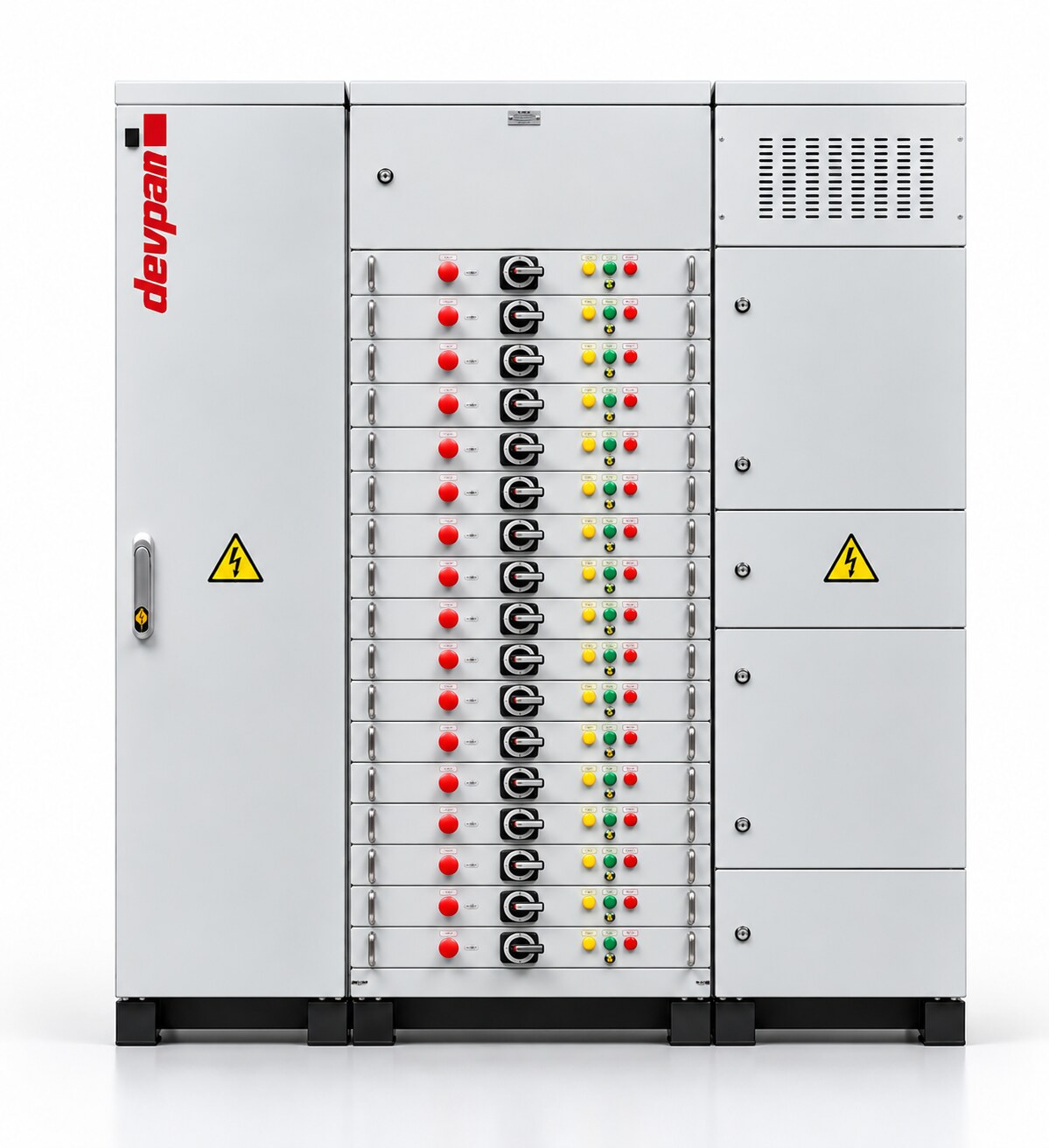
When a facility has dozens of motors, grouping all motor feeders on a common busbar system instead of installing a separate panel for each one saves space and cabling and simplifies operation. That is exactly what a motor control center does: it is an arrangement of functional units fed from the main busbar, each with its own protection and control devices.
In DevControl, each motor feeder is treated as an independent module. The module includes a motor protection circuit breaker, contactor, overload protection, local control and, if required, a soft starter or frequency converter. Modules can be fixed or, in facilities that cannot tolerate interruptions, designed as withdrawable units.
On the control side, different levels are possible, from simple relay-logic solutions to full automation managed via PLC and touch-screen HMI. By connecting the switchboard to a SCADA system via Modbus, Profibus or Profinet, the status of all motors can be monitored from a single screen.
Technical Specifications
DevControl motor control centers are configured according to the plant’s motor list and operating scenario. The table below summarizes typical design options.
| Property | Value / Option |
|---|---|
| Applicable standard | IEC 61439-1, IEC 61439-2 |
| Starting methods | Direct on line (DOL), star-delta, soft starter, AC drive (VFD) |
| Motor protection | Motor protection circuit breaker (MPCB), thermal overload relay, electronic motor protection relay, PTC/thermistor relay |
| Functional unit | Fixed-connection, plug-in or withdrawable |
| Internal separation | Form 3b, Form 4a, Form 4b |
| Control | Relay logic or PLC based control; local/remote selector switch |
| Operator interface | Touch-screen HMI, indicator lamps, ammeter, hour meter |
| Communication | Modbus RTU/TCP, Profibus DP, Profinet, EtherNet/IP |
| Drive compartment | Installed in a separate compartment, filtered fan or air conditioning, EMC-compliant wiring |
| Soft starting | Soft starter option with bypass contactor |
| IP rating | IP31 / IP41 / IP54 |
| Enclosure | Cold-rolled (DKP) sheet steel; frame 2 mm, doors and covers 1.5 – 2 mm; electrostatic powder coating RAL 7035 |
| Cable connection | Bottom or top; separate terminal compartment, numbered and labeled wiring |
| Redundancy | Dual busbar supply, interlocked transfer arrangement (optional) |
The values given are typical application ranges; final ratings are determined after the single-line diagram, short-circuit and selectivity calculations.
Four Key Decisions in MCC Design
Maintenance without shutdown with withdrawable modules
In a withdrawable design, a faulty motor feeder module can be removed and replaced with a spare while the switchboard stays energized. In continuous-production facilities this cuts downtime from hours to minutes and lowers the total cost of ownership.
Drive and soft starter integration
Frequency converters generate heat and inject harmonics into the network. That is why drive compartments are planned separately, the heat load is calculated and ventilation or air conditioning is selected; EMC-compliant shielded motor cables and a proper earthing arrangement are used.
PLC, HMI and SCADA integration
Motor status, current values, operating hours and fault records can be collected via the PLC and sent to HMI and SCADA screens. Fault finding thus starts in the control room, not in the field.
Form of separation and operator safety
In MCC panels, it must be possible to work on one motor feeder while the other motors keep running. That is why Form 3b and Form 4b are the most common forms of separation in MCC panels.
Where Are MCC Panels Used?
Motor control centers are used in facilities where many motors operate together and central monitoring is needed.
- Water and wastewater treatment plants
- Food, chemical and pharmaceutical production facilities
- Cement, mining and aggregate plants
- Automotive and household appliance production lines
- Pumping stations
- Mechanical services of shopping malls and hospitals
- Data center cooling systems
- Power plants and utilities
Relevant Technical Information
Frequently Asked Questions
What is the difference between an MCC and a motor control panel?
A motor control panel is usually a standalone panel that feeds one or a few motors. An MCC, on the other hand, is a system of modular functional units that houses dozens of motor feeders on a common main busbar. Because each feeder is built in a standard module layout, expansion and maintenance are much easier in an MCC.
When is a withdrawable MCC necessary?
A withdrawable design is preferred in facilities where production stoppages are costly, maintenance windows are very short or operations run continuously in shifts. Because a faulty module can be removed from the energized switchboard and replaced with a spare, there is no need to shut down a whole section. If interruptions can be tolerated, fixed modules are more economical.
What additional measures are needed for VFD-driven motor feeders?
Three topics stand out: heat, harmonics and EMC. Ventilation or air conditioning is calculated per compartment for the heat generated by the drives; if necessary, a line reactor or filter is added against harmonics injected into the network; and interference is limited on the motor side with shielded cables and proper earthing.
How is the MCC panel connected to the SCADA system?
Electronic protection relays and drives in the motor feeder modules are read via Modbus RTU/TCP, Profibus DP or Profinet through the PLC or a communication gateway in the switchboard. The collected data is transferred to the SCADA software, so motor status, current, operating hours and fault records can be monitored from a single screen.
Other Low Voltage Switchboards


Send us your motor list and let’s plan your MCC together
If your motor ratings, starting methods and operating scenario are known, we can work out the module plan, form of separation and busbar cross-section together. For your automation needs, see also our automation and SCADA services.
Request a quote