
Product Family
Low Voltage Panel Family
Low voltage panels are switchgear assemblies that distribute, protect, meter and control power below 1,000 V AC within a facility. Devpan’s five panel families cover this entire chain, from the transformer secondary to the final load; all are designed, manufactured and tested in our own plant to IEC 61439-1 / IEC 61439-2 .MDB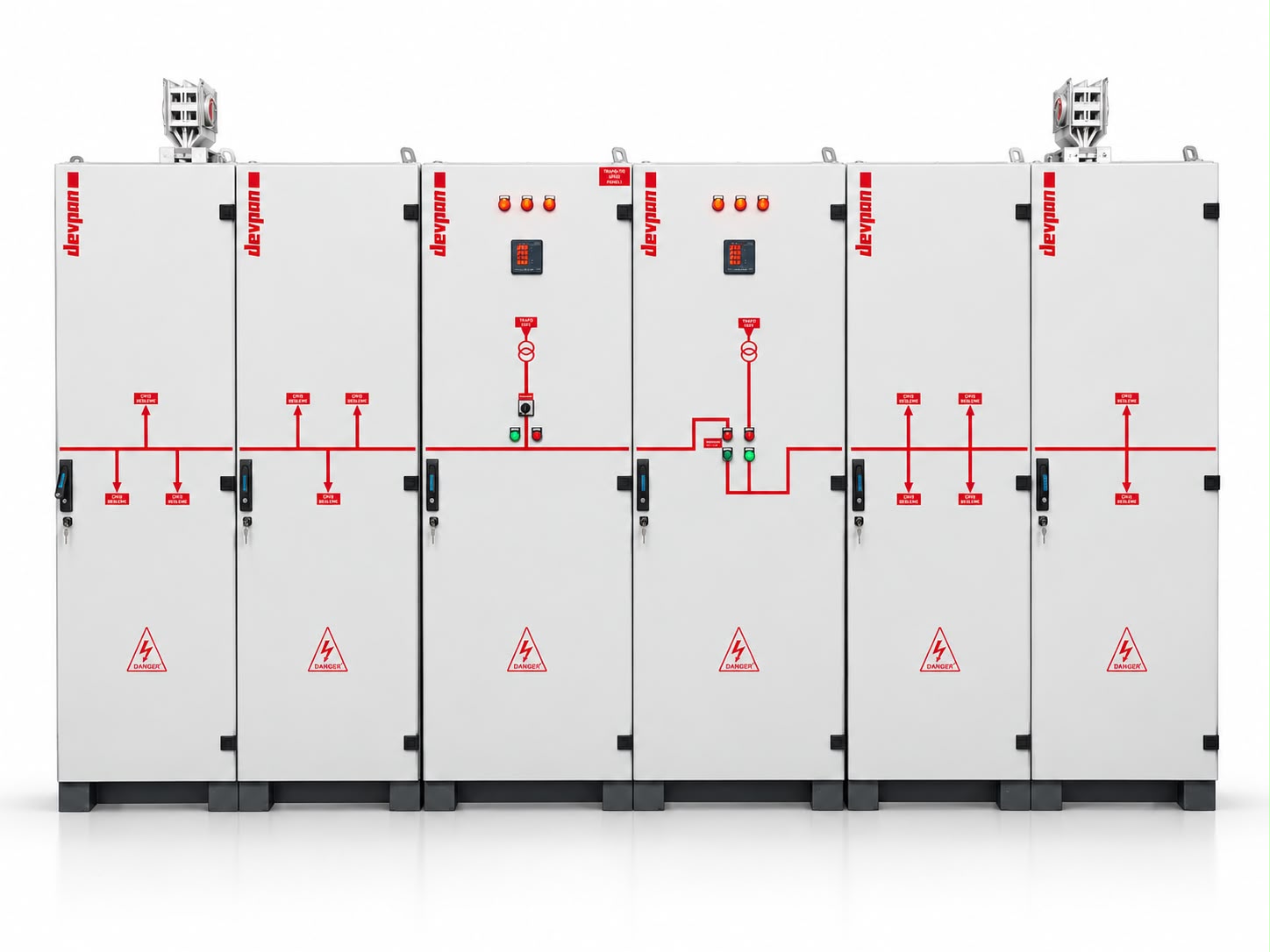 DevPanelMain Distribution BoardReceives all the power from the transformer or generator; compartmented panel housing the main breaker, main busbar and metering.View productMCC
 DevControlMotor Control CenterCentralizes all motor feeders in fixed, plug-in or withdrawable modules.View productSDB
 DevBoxSub-Distribution BoardFeeds final circuits by floor, building or zone; compact sub-distribution board, wall-mounted or floor-standing.View productPFC
 DevCompPower Factor Correction PanelPower factor correction with stepped reactive power; contactor- or thyristor-switched panel.View productLPDB
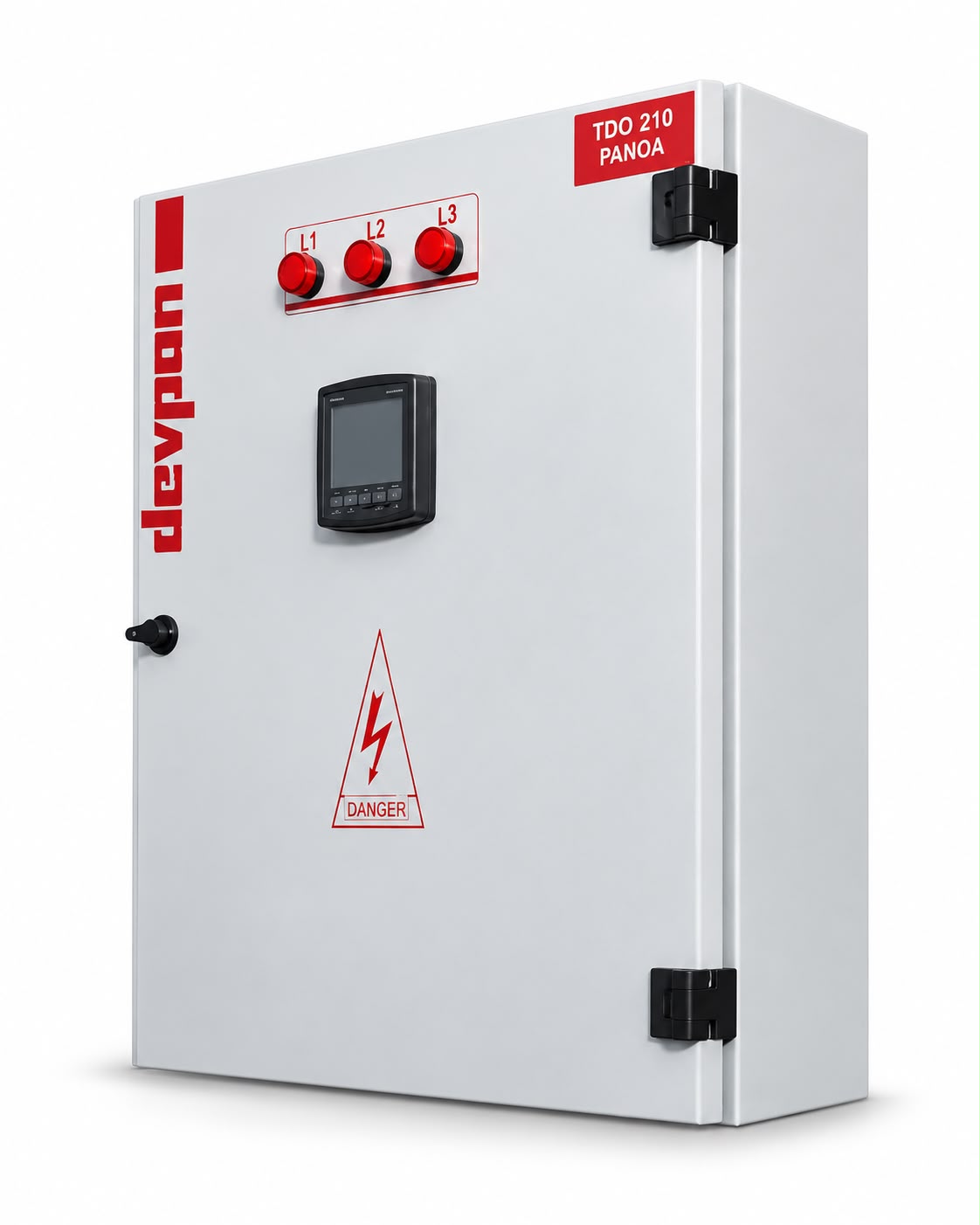 DevPowerLighting and Power PanelManages lighting and socket circuits with group control, energy metering and fault signaling.View product
DevPanelMain Distribution BoardReceives all the power from the transformer or generator; compartmented panel housing the main breaker, main busbar and metering.View productMCCDevControlMotor Control CenterCentralizes all motor feeders in fixed, plug-in or withdrawable modules.View productSDBDevBoxSub-Distribution BoardFeeds final circuits by floor, building or zone; compact sub-distribution board, wall-mounted or floor-standing.View productPFCDevCompPower Factor Correction PanelPower factor correction with stepped reactive power; contactor- or thyristor-switched panel.View productLPDBDevPowerLighting and Power PanelManages lighting and socket circuits with group control, energy metering and fault signaling.View productSelection Guide
Which Panel Goes Where?
Panel selection depends on the supply point, the current to be carried, ambient conditions and whether the operation can tolerate outages during maintenance. The table below compares where the five product families sit in the installation.| Panel family | Location and role in the installation | Typical rated value | Key equipment |
|---|---|---|---|
| DevPanel (MDB) | Downstream of the transformer or generator; the facility’s main distribution point | 630 – 6300 A | Air circuit breaker (ACB), main busbar system, energy analyzer |
| DevControl (MCC) | Production lines, pump and fan groups, process and treatment plants | 630 – 6300 A main busbar | Motor protection circuit breaker (MPCB), contactor, soft starter, VFD |
| DevBox (SDB) | Sub-distribution by floor, building, workshop or zone | 100 – 1600 A | MCCB, miniature circuit breakers (MCB), RCD, SPD |
| DevComp (PFC) | Next to the main panel or separate compensation room | 12.5 – 1000 kVAr | Power factor controller, capacitor steps, detuned reactor |
| DevPower | Floor or zone panel grouping lighting and socket circuits | 100 – 800 A | Group control contactors, time relays, RCD, fault signaling |
The values in the table are typical application ranges; final values are set after the single-line diagram, selectivity study and short-circuit calculation.
Design Principles
Standards and Design Principles
The quality of a low voltage panel depends more on how the panel is designed as a system than on the components inside. Four points are decisive in Devpan’s design process.01
IEC 61439 verification
Low voltage switchgear assemblies are verified for temperature rise, short-circuit withstand, dielectric properties, IP rating and mechanical strength according to IEC 61439-1 (general rules) and IEC 61439-2 (power switchgear assemblies). After manufacturing, every panel undergoes routine verification.02
Busbar systems and short-circuit withstand
Main and distribution busbars are sized for rated current, short-time withstand current (Icw) and peak withstand current (Ipk). Support spacing is set by electrodynamic forces and temperature rise.03
Internal separation by form
The degree of separation between busbars, functional units and terminals is selected between Form 1 and Form 4b . The more work must be done without shutting down the supply, the higher the form selected.04
IP rating and ambient conditions
The IP rating is selected for the dust, moisture and water risks of the installation room, and the IK rating for the impact risk. Ventilation or air conditioning is sized for power losses and internal temperature rise at high ambient temperatures.Production Process
From Design to Commissioning
Because design, manufacturing and commissioning are done by the same company, responsibility stays in one place. Our project design and project management teams follow the process from start to finish.- Needs analysis and single-line diagramThe facility’s load schedule, supply sources and generator/UPS scenarios are defined; the single-line diagram is built on short-circuit and selectivity calculations.
- Project design and approvalLayout, busbar routing, terminal plan and cable entries are drawn; manufacturing starts only after customer approval.
- Sheet metal work and enclosure manufacturingSheet steel is cut and bent, then powder coated after welding and surface preparation.
- Busbar manufacturing and installationElectrolytic copper busbars are fabricated, switchgear and wiring are installed and labeled; tightening torques are recorded.
- Routine verification and commissioningVisual inspection, wiring check, functional and dielectric tests; on-site installation and commissioning support.
In short: which panel does what?
- DevPanel (MDB): main distribution board downstream of the transformer; main busbar up to 6300 A, Forms 1–4b.
- DevControl (MCC): motor control center; fixed, plug-in or withdrawable motor feeders with soft starter and VFD integration.
- DevBox (SDB): floor and zone sub-distribution board; modular devices, residual current protection and SPD.
- DevComp (PFC): power factor correction panel; contactor or thyristor steps, detuned reactors for harmonic loads.
- DevPower: panel managing lighting and socket circuits with group control and energy metering.
Frequently Asked Questions
Frequently Asked Questions
Which standard are low voltage panels built to?
Low voltage switchgear assemblies are built to the IEC 61439 series. Part 1 (IEC 61439-1) sets the general rules for all assemblies, and Part 2 (IEC 61439-2) the specific rules for power switchgear assemblies. The standard requires the panel to be verified as a whole, so component certificates alone are not enough.
What is the difference between a main distribution board and a sub-distribution board?
The main distribution board (MDB) receives the full power from the transformer or generator, has a busbar system rated for high short-circuit currents and usually an air circuit breaker incomer. The sub-distribution board (SDB) splits the power received from the MDB into smaller circuits by floor, zone or machine; its current rating and short-circuit withstand are much lower.
When is a withdrawable MCC preferred?
Where production stoppages are costly, a withdrawable motor control center is preferred. A faulty motor feeder can be withdrawn and replaced with a spare while the panel stays energized, cutting downtime to minutes. With fixed modules, the section concerned must be de-energized for the same operation.
Why use detuned reactors in a PFC panel?
In facilities with non-linear loads such as VFDs, UPS systems and LED drivers, harmonic currents flow in the network. Capacitor steps can resonate with these harmonics and draw excessive current. A detuned reactor in series with each step shifts the resonant frequency below the harmonic orders, protecting both the capacitors and the network.
How to choose the form of separation?
The form of separation defines how busbars, functional units and terminals are separated from each other. If maintenance can be done de-energized, Form 2 may be enough; if one feeder must be worked on while the others keep running, Form 3b or 4b is selected. The choice considers the operating scenario and occupational safety requirements.
Where are Devpan low voltage panels used?
Devpan low voltage panels are used in residential and mixed-use projects, shopping malls, hospitals, schools, data centers and manufacturing facilities. You can find application examples on our reference projects page.