
The Pepsi Factory in Uzbekistan is a beverage production plant running filling lines, syrup preparation and refrigeration around the clock. Devpan supplied the MCCs, main distribution, power factor correction and sub-distribution boards.

Electrical Profile of the Project
- LocationUzbekistan
- Building typeManufacturing plant
- Installed power≈ 5,000 kVA
- Transformer configuration2 × 2,500 kVA
- Main busbar rated current2 × 4,000 A
- Short-time withstand current (Icw)80 kA / 1 s
- Devpan scopeLow voltage switchboards, engineering and site coordination
- Verification standardIEC 61439-1, IEC 61439-2
About the Project
Beverage bottling plants depend on large numbers of motors: conveyors, blow moulders, fillers, labellers, CIP cleaning systems and refrigeration compressors. A single line stoppage means lost product and repeated cleaning cycles, so downtime is expensive. Humid wash-down areas, dust and temperature swings also make the mechanical and environmental robustness of the switchboards a real design concern rather than a formality.
For a plant of this scale, a typical arrangement is a 2 × 4,000 A main distribution board with bus coupler, fed by two 2,500 kVA transformers and rated for 80 kA / 1 s. Process motors are grouped line by line in Form 4b, IP54 DevControl MCCs, so a fault on one line does not affect the others. Two 1,250 kVA generators protect refrigeration and critical process loads, while DevComp panels offset the reactive power drawn by the heavy motor load.
Devpan Scope and Switchboard Architecture
Devpan’s scope covers process and building distribution from the transformer incomers to the production line motors.
- Motor control centres (DevControl): Form 4b, IP54, withdrawable and drive feeders for filling, blow moulding, CIP and refrigeration lines.
- Main distribution boards (DevPanel): 2 × 4,000 A, 80 kA / 1 s, with bus coupler and generator changeover.
- Power factor correction (DevComp): detuned compensation stepped to the plant’s motor load.
- Sub-distribution boards (DevBox): warehouse, laboratory, administration and utility buildings.
- Lighting and power panels (DevPower): production hall, warehouse and site lighting.
Technical Configuration
| Installed power | ≈ 5,000 kVA |
|---|---|
| Transformer configuration | 2 × 2,500 kVA |
| Medium voltage level | 10 kV |
| Low voltage / frequency | 400 / 230 V, 50 Hz |
| Main busbar rated current | 2 × 4,000 A |
| Short-time withstand current (Icw) | 80 kA / 1 s |
| Form of internal separation | Form 4b |
| Degree of protection (IP) | IP54 |
| Generator back-up | 2 × 1,250 kVA |
| Verification standard | IEC 61439-1, IEC 61439-2 |
Devpan Products Used in This Project
Project-Specific Engineering Topics
Line-by-line segregation
Each production line has its own MCC section, so maintenance or a fault stops only that line.
Wash-down resilience
IP54 enclosures protect internal equipment in humid and dusty production areas.
Drives and harmonics
Variable speed drives on conveyors and pumps generate harmonics, which detuned compensation keeps under control.
Refrigeration continuity
Refrigeration compressors are connected to a generator-backed section to protect product quality during an outage.
Frequently Asked Questions
What is the installed power for the Pepsi Factory in Uzbekistan?
For a beverage plant of this scale the installed power is approximately 5,000 kVA, with a typical transformer configuration of 2 × 2,500 kVA. The main busbar is planned at 2 × 4,000 A with 80 kA / 1 s withstand, on a 10 kV MV supply and with 2 × 1,250 kVA standby generators.
Why are withdrawable MCC units preferred?
Withdrawable motor feeders allow a faulty unit to be swapped for a spare within minutes, minimising line downtime and lost production.
Why is IP54 needed in a beverage plant?
Filling and CIP areas involve humidity, splashing water and dust. IP54 enclosures shield internal equipment from these conditions and extend board life.
Similar Reference Projects
 Portakal Engineering FactoryManufacturing plant · Türkiye
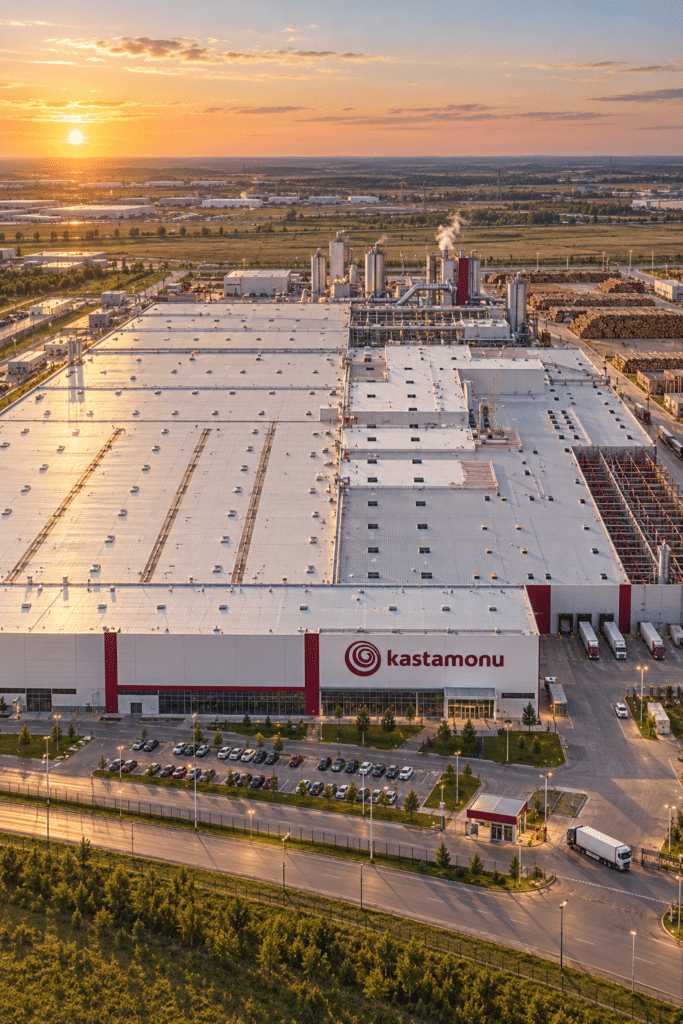 Kastamonu Entegre Tatarstan PlantManufacturing plant · Tatarstan, Russia
 Battery Production Plant ProjectManufacturing plant · Russia
Do you have a project of a similar scale?
Send us your single-line diagram, your transformer rating or simply your load list. Our engineering team runs the short-circuit and discrimination study and defines the form of separation and busbar cross-section with you.
Request a quotation