
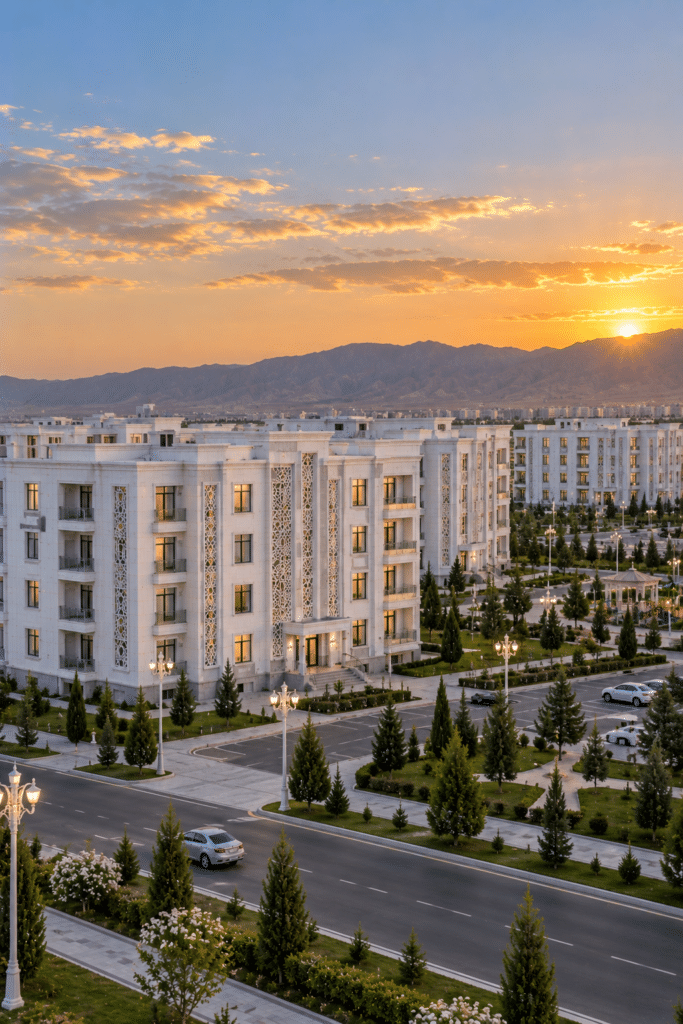
The Ashgabat Taslama Housing Project is a residential development in Ashgabat, the capital of Turkmenistan. Devpan supplied the LV switchboard infrastructure from the main distribution down to the apartment incomers.
Electrical Profile of the Project
- LocationAshgabat, Turkmenistan
- Building typeResidential complex
- Installed power≈ 3,200 kVA
- Transformer configuration2 × 1,600 kVA
- Main busbar rated current2 × 2,500 A
- Short-time withstand current (Icw)65 kA / 1 s
- Devpan scopeLow voltage switchboards, engineering and site coordination
- Verification standardIEC 61439-1, IEC 61439-2
About the Project
Electricity use in modern housing has changed considerably: inverter air conditioners, LED lighting, electric kitchen appliances and lift drives raise both load density and harmonic content. In Ashgabat, summer temperatures above 40 °C stretch air-conditioning use over long hours and keep distribution equipment heavily loaded for extended periods. For residents, the most visible problem is a fault in one flat tripping an entire floor or block, which makes protection selectivity and ease of maintenance decisive design criteria in residential distribution.
A housing project of this scale typically relies on about 2 × 1,600 kVA of transformer capacity supplied from the 10 kV network. DevPanel main boards with 2 × 2,500 A busbars, 65 kA / 1 s withstand and Form 3b – Form 4a segregation distribute block feeders within a coordinated selectivity scheme. DevBox boards in each block arrange floor and apartment circuits in a tidy, accessible layout. DevComp panels are sized for the reactive power and harmonics of inverter loads, DevPower panels manage common-area and exterior lighting, and a generator of around 1,000 kVA backs up life-safety loads.
Devpan Scope and Switchboard Architecture
Devpan supplied all LV distribution boards for the project, from the transformer outgoing side to the apartment incomers.
- Main distribution boards (DevPanel): 2 × 2,500 A busbars, 65 kA / 1 s, coordinated selectivity and a generator transfer section.
- Block, floor and apartment boards (DevBox): IP31 – IP41 sub-distribution boards with easy access to metering and outgoing circuits.
- Power factor correction (DevComp): Automatic, detuned compensation suited to inverter air-conditioning and LED loads.
- Lighting panels (DevPower): Programmable control of car park, stairwell, landscape and façade lighting.
Technical Configuration
| Installed power | ≈ 3,200 kVA |
|---|---|
| Transformer configuration | 2 × 1,600 kVA |
| Medium voltage level | 10 kV |
| Low voltage / frequency | 400 / 230 V, 50 Hz |
| Main busbar rated current | 2 × 2,500 A |
| Short-time withstand current (Icw) | 65 kA / 1 s |
| Form of internal separation | Form 3b – Form 4a |
| Degree of protection (IP) | IP31 – IP41 |
| Generator back-up | 1 × 1,000 kVA |
| Verification standard | IEC 61439-1, IEC 61439-2 |
Devpan Products Used in This Project
Project-Specific Engineering Topics
Protection selectivity
Time and current discrimination between main, block and apartment breakers ensures a fault in one flat affects only that flat.
Harmonic content
Because of inverter air conditioners and LED drivers, neutral conductors and compensation steps are sized for harmonic load.
Thermal management
Busbar sections are selected with temperature derating for long periods of high load, and switchroom ventilation is planned accordingly.
Fire-safety supplies
Fire pumps, smoke extraction fans and emergency lighting are fed from separate circuits designed to stay energised during a fire.
Frequently Asked Questions
What is the installed power of the Ashgabat Taslama Housing Project?
For a housing project of this scale, the installed power is approximately 3,200 kVA with a typical transformer configuration of 2 × 1,600 kVA. The main busbar is typically rated 2 × 2,500 A with 65 kA / 1 s withstand; the MV level is 10 kV and standby power comes from a generator of around 1 × 1,000 kVA.
Why is protection selectivity important in housing?
Selectivity ensures the breaker closest to the fault opens first, so a short circuit in a single apartment does not disconnect a whole floor or block.
Which loads are transferred to the generator?
Typically lifts, fire pumps, booster pumps, smoke extraction fans and common-area emergency lighting; apartment loads are usually left out of the standby scope.
Similar Reference Projects
 Al Hamra Residential ProjectResidential complex ·
 Dubai Land Residential ComplexResidential complex · Dubai, United Arab Emirates
 Nekrasovka Residential ComplexResidential complex · Moscow, Russia
Do you have a project of a similar scale?
Send us your single-line diagram, your transformer rating or simply your load list. Our engineering team runs the short-circuit and discrimination study and defines the form of separation and busbar cross-section with you.
Request a quotation