
Kiffa Substation is a switchyard and distribution hub in the Kiffa region of inland Mauritania. Devpan supplied Dev24/36 modular medium-voltage switchgear and the low-voltage auxiliary distribution boards.

Electrical Profile of the Project
- LocationKiffa, Mauritania
- Building typeSwitchyard and substation
- Installed power≈ 2,500 kVA
- Transformer configuration2 × 1,250 kVA
- Main busbar rated current2 × 1,600 A
- Short-time withstand current (Icw)50 kA / 1 s
- Devpan scopeMedium voltage switchgear, low voltage switchboards and engineering
- Verification standardIEC 61439-1, IEC 61439-2
About the Project
A substation in the Sahel sits at the end of long transmission lines and acts as the node that supplies an entire region. Inland locations such as Kiffa see very high summer temperatures, sandstorms that carry fine dust everywhere and wide day-night temperature swings that can cause condensation. Because reaching the site takes time, equipment must run reliably for long periods without intervention; a single panel failure can leave a large area without power.
For a substation of this scale, the typical arrangement is a line-up of metal-enclosed modular panels at 33 kV forming incoming, outgoing, metering and transformer bays. On the distribution and auxiliary side, approximately 2 × 1,250 kVA transformers feed a low-voltage main board of 2 × 1,600 A rated 50 kA / 1 s. IP54 – IP55 enclosures protect against dust, while a generator of around 800 kVA keeps protection, control and communication systems running during outages.
Devpan Scope and Switchboard Architecture
Devpan’s scope extends from the medium-voltage switchgear to the substation’s auxiliary and service distribution boards.
- Medium-voltage switchgear (Dev24/36): 33 kV incoming, outgoing, metering and transformer protection bays in a metal-enclosed modular design.
- LV main distribution boards (DevPanel): typically 2 × 1,600 A, 50 kA / 1 s, Form 3b, with bus coupler and generator transfer.
- Sub-distribution boards (DevBox): IP54 – IP55 boards for the control building, rectifiers, lighting and yard sockets.
- Power factor correction (DevComp): automatic stepped compensation for reactive power balancing on distribution feeders.
Technical Configuration
| Installed power | ≈ 2,500 kVA |
|---|---|
| Transformer configuration | 2 × 1,250 kVA |
| Medium voltage level | 33 kV (Dev24/36) |
| Low voltage / frequency | 400 / 230 V, 50 Hz |
| Main busbar rated current | 2 × 1,600 A |
| Short-time withstand current (Icw) | 50 kA / 1 s |
| Form of internal separation | Form 3b |
| Degree of protection (IP) | IP54 – IP55 |
| Generator back-up | 1 × 800 kVA |
| Verification standard | IEC 61439-1, IEC 61439-2 |
Devpan Products Used in This Project
Project-Specific Engineering Topics
Dust and heat management
IP54 – IP55 enclosures, filtered ventilation and derating calculations are handled together for sandstorms and high ambient temperatures.
Condensation control
Thermostatic heaters and humidity control inside MV panels protect insulation surfaces against day-night temperature swings.
Auxiliary supply continuity
Protection relays, breaker controls and telecoms run from a rectifier and battery system, with generator backup on the LV side.
Remote monitoring
Digital protection relays connected to SCADA allow event logging and fault analysis from a distant control centre.
Frequently Asked Questions
What are the typical power figures for a substation of the scale of Kiffa?
For a substation of this scale the installed power on the distribution and auxiliary side is approximately 2,500 kVA, with a typical transformer configuration of 2 × 1,250 kVA. Medium voltage is 33 kV; the LV main busbar is typically 2 × 1,600 A rated 50 kA / 1 s, supported by a generator of around 800 kVA.
What role does Dev24/36 switchgear play in a substation?
The modular metal-enclosed panels are arranged as separate bays for line incomers, distribution feeders, metering and transformer protection, and new panels can be added when the substation is extended.
Which IP rating suits a hot, dusty climate?
IP54 – IP55 is preferred for rooms near open areas or with limited air conditioning; it restricts dust ingress and splashing water, though derating must be considered in the thermal design.
Similar Reference Projects
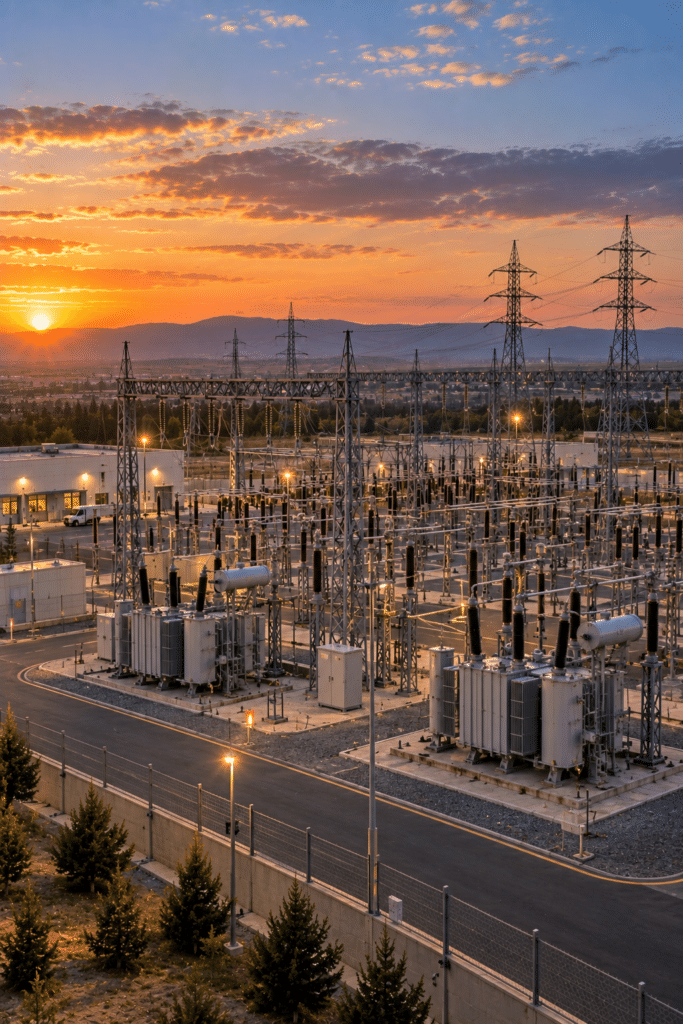 Ganja SwitchyardSwitchyard and substation · Ganja, Azerbaijan
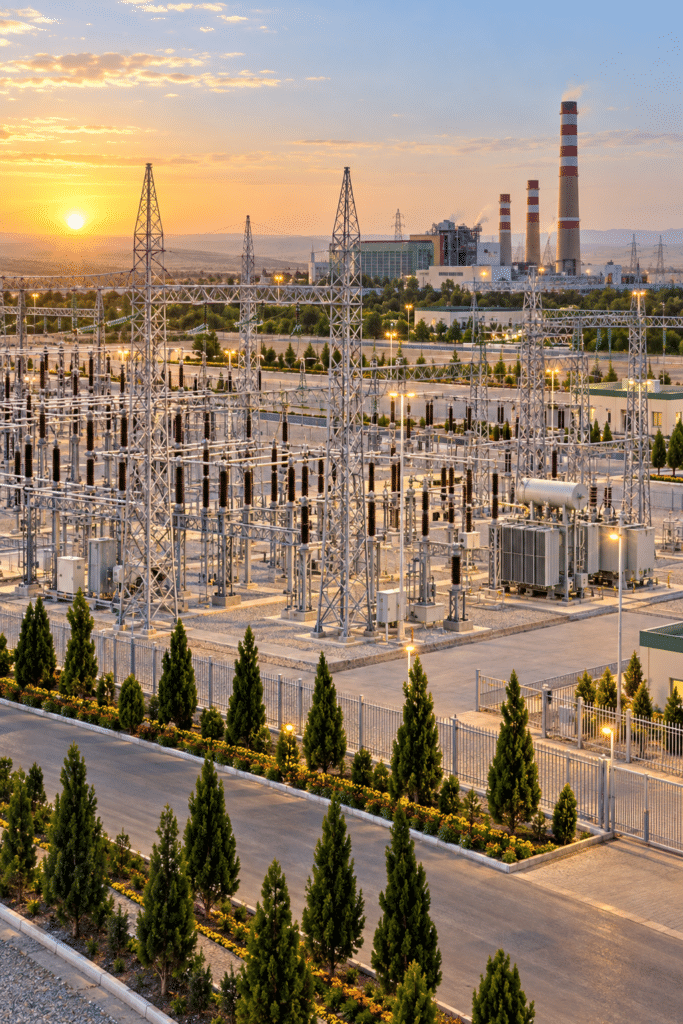 Mary SwitchyardSwitchyard and substation · Mary, Turkmenistan
 EllaLink Data Centre NouadhibouData centre · Nouadhibou, Mauritania
Do you have a project of a similar scale?
Send us your single-line diagram, your transformer rating or simply your load list. Our engineering team runs the short-circuit and discrimination study and defines the form of separation and busbar cross-section with you.
Request a quotation